
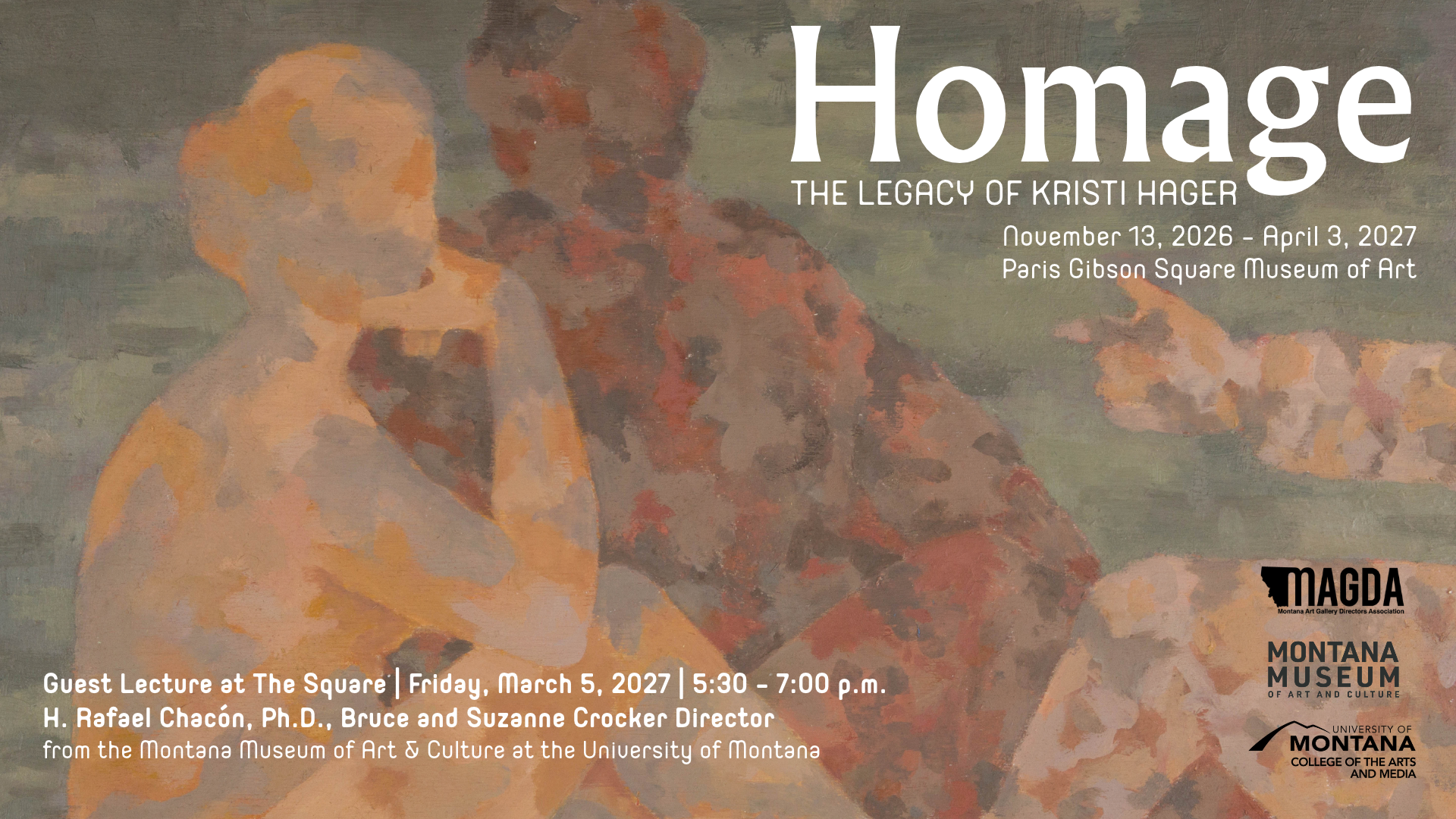
HOMAGE: The Legacy of Kristi Hager
November 13, 2026 – April 3, 2027
Sponsored by the Montana Museum of Art & Culture at the University of Montana
Traveling via the Montana Art Gallery Directors Association (MAGDA)
Listen to the audio here!
-
I was introduced to a Bay Area painter named Gordon Cook. And when I visited Gordon and I looked at his paintings and I was like, I want to paint like that. You know, he would just do paintings of a bag of garbanzo beans.
I mean, just the paper bag sitting in neutral space. A party hat, you know, kind of a glittery New Year's Eve party hat. He was a pretty large man, but he just sat at the easel, and his paintings were maybe, at most, 12 by 12 inches.
We really didn't talk about painting, except I showed him my first painting, which was of hay bales — just a field of hay bales. It was a very, very simple, limited color palette.
And he just said, ‘learn to love the paint.’ Because I was fighting the paint. I was trying to control the paint.
And I realized, yeah, love the paint. You have to have a conversation. I don't always do that; when I find myself really tightening up, I go, ‘you are not loving the paint. You're trying to control and dominate the paint.’ It's a constant battle.
So that was the one thing he said. And then the other thing, I think, when I left the Bay Area and moved to Butte, Montana, and I had a studio there, he just said, ‘paint simple things for five years, and you'll learn to paint.’ You know, that's like the 10,000-hour thing that people say now.
But at the time, I went, ‘that makes sense. Five years, no problem.’ I didn't even particularly say I'm on year one or two or three.
I just started getting simple things, a dog dish, a cake tin, stuff I would find at the thrift store that I thought were interesting artifacts of our culture, or a boxing glove, a pair of swim fins, or a pair of hip waders. I would just set them up as a neutral background, a card table, a slinky. And one day, probably it was about five years, I felt like whatever I want to paint, I can paint it.
If I want to render this as a three-dimensional object on a canvas, just with a neutral background, I'm not telling a story, I'm not trying to have a super high concept, except I find these objects either amusing or interesting, or it's a meditation, like when I would spend a lot of time with the card table, it was a feeling of communion with this object.
Anyway, I went, ‘oh yeah, whatever I want to paint, I can paint it.’ And that's when I said, ‘okay, I had a big show at Paris Gibson Square of all these simple, single object still lifes, and I really liked the show. And then as I was walking around the show, I went, I sort of feel like I'm wearing somebody else's coat, Gordon's coat.’ And I said, ‘I feel confident in my painting, and I can take off the coat.’ And then I probably tried a lot of dumb stuff.
I think eventually I really broke into figure painting, which was something Gordon never did. In the camo for the women figures, it was a lot about how we build in our own camouflage. I felt like I had, in an unconscious way, protected myself from potential danger that you're taught from, I don't know, whenever you're old enough to be bait for somebody.
Be wary, and don't attract attention to yourself. And so, I realized, even though I didn't literally wear camo, that I had, in many situations, had this level of camouflage, psychological camouflage, to keep myself safe. And I was unaware of it until I had done like 15 of these paintings, because I thought I was doing it about women in Iraq who are attacked by their own, all the shame and humiliation and trauma of having been attacked by your own fellow soldiers. And then women who are just, it's a tactic of war.
The latest series, Women on Earth, I feel like our culture isn't good at expressing grief. I mean, you can have grief in a specific moment, but I was just thinking of the whole notion of lamentations.
There's a whole book of the Bible called Lamentations, but it's kind of a cultural acknowledgement that we're losing things in a massive way, and you carry on, and you don't despair, but you need to acknowledge there's a lot of loss here. So, I had worked with poses with the model so that she's seated, but she has her legs kind of akimbo, or she's bracing herself in a way so that I would do the drawing, and then when I got home, I would add a curved earth under her so she's like sitting on top of the earth. And then depending on what's going on with patches of color, the color can come through her body, through the earth.
It's like we're all connected, and our actions influence out there. The outside is affecting us. So even though there's her contour, all the colors can come in and out of her or the earth or the space around the earth, and it's done in a way that isn't trying to simulate clouds or the ocean.
It's just swashes of color, and some look more like an intrusion, and some just look like this is just sort of a natural, benign occurrence. A bird just came by, you know. So that's kind of the most recent iteration of the figures.
And I felt like the women on earth are, in general, just a little more attuned and under assault right now. So, I also drew them having multiple arms, like I was thinking the goddess, Shakti. So, they have sometimes multiple arms.
The arms are in different positions the way they are in that Hindu goddess, and once in a while I give her an extra leg, like she's kicking something away. But when I researched why there are so many arms on this goddess, it said because there's so much work to be done. She needs all the arms, and also another description was she's dispelling ignorance and fighting evil.
I mean, there's so much work to be done. And so, when I did titles, I gave these. Each one was just one woman on top of this kind of curved horizon line.
It's like she's just trying to maintain balance. Sometimes you need both arms to just do that. Or she's receiving wisdom because sometimes you don't want to receive wisdom. I don't know. So that wasn't just ‘I'm going to save the world,’ but as a woman alive, I have to receive wisdom, and I have to defend and protect. So, I used words like that.
I would just look at how the hand gestures worked out, and I would feel like, okay, she's in the process of protecting her heart at the same time she's warding something away. And it's like trying to work through with a female figure that doesn't look passive and poses that don't look like a stop action, like gets them running. I wasn't interested in that, but I wanted them to have agency and then to pick poses that weren't pretty or predictable or even just demure. They're not demure. And so that's been a long progress because we're so used to doing what we've seen in the art history books.
People look at it and say, I can't tell whether that's a painting or a photograph, and I'm always surprised, but it's because the composition is not what they assume from a photograph and what they assume might be from a painting, but that whole thing was totally in that frame of mind, like let's get the craziest, wildest flowers at the market and put them on backgrounds that I feel there's some kind of magic in.
These are like wallpaper flowers, but somehow there's a relationship to the live flower, enough that sometimes people get confused, like which is the real flower, which is the flower on the fabric? But it is that exuberance, just like the exuberance and multiplicity of nature, even when they're cultivated, like humans came up with the dinner plate dahlia, and they're all so wild. And then maybe there's some point where you have to say, ‘wait, I have to take something out of this. It just went too far.’
Part of it is learning when to take something away. I guess the other thing that is harder to explain, but I think you'll know when you're doing something that only you could do, and that's, I think, really important because we can do stuff that we think other people will like. You know, we can do homages to other artists who came before, but at some point, I think the work that's worth doing is the work that
nobody else would do because of your own peculiar idiosyncrasies.
When I was in undergraduate school as an architecture major, we were required to take a drawing class called Descriptive Drawing, and it was taught by a painter named Neil Welliver who taught at Yale and Penn, and he showed in major galleries in New York, and he did big landscapes. So, at some point I said, ‘I want to do plein air painting. I've not really tackled landscape.’
It seems taboo in a way. Even now, you know, if you're a 21st century painter, you just can't be quite that direct. Anyway, I started doing these plein air paintings of Rattlesnake Creek as my muse because it was close, and I just loved sitting there and painting in real time and not in my studio and having to respond to what was happening right in front of me.
And then one time I went, ‘what would Neil do? Neil would make this really big.’ And so I thought, ‘well, before I die, I want to attempt to do this.’ I had one particular piece of Rattlesnake Creek that I thought, this gouache painting that I did, Creekside, plein air, I think it merits trying to do it big.
I don't know if it'll work, but I'm just going to immerse myself and look at Neil Welliver's coffee table book, and I'm not going to try to copy what he does, but I'm going to learn from it because there's a reason why it's working for me. It isn't about so much illusionistic space of the landscape, but it isn't just completely flattening it out like Cézanne. The whole surface is alive, that's all I can say.
And so, I kept that in mind. Anyway, I completed it, and it just was a victory to just do it. And it took some time, actually, longer than I thought, just going to that scale, which for me, four feet by six feet is big. — Kristi Hager
Gallery Audio | Musings from Kristi Hager
Kristi’s Voice and Enduring Friendships
The audio recording in this exhibition, featuring Kristi Hager’s musings on art, stems from interviews conducted by her close friend Leslie Van Stavern Millar beginning in summer 2024. These excerpts are testimonies to the rich and insightful conversation the fellow artists shared over many years. Millar writes:
Last summer when I realized Kristi was running out of time, I decided to record conversations with her typical of what we had shared during our thirty-year (art) friendship. I interviewed Kristi 6 - 8 times over a 2.5 month period, meeting for about 20 minutes to over an hour each time, depending on her energy and our schedules. During the sessions, I took a back seat in order to focus on whatever she had to say. We ranged over a variety of topics, most of which I proposed fresh each time we met. I wanted the dialog to be relaxed and spontaneous, so other than thinking about ideas between the time I last saw her, Kristi had little advance notice of what topics we would address. I drove in from Arlee to interview her one last time 3 days before my departure on October 17th to Italy and Germany, not being confident she would be alive when I returned.
The interviews grew out of a friendship centered on our mutual art concerns. Since the 1990's we have had many lively conversations about making art, art materials, selling art, exhibiting, people in the art world, what we liked and didn't like, etc. This audio project helps keep Kristi and our unique friendship alive for me. I am hopeful it will enhance the exhibit and amplify Kristi's voice.
The MMAC is grateful for these precious interviews recorded by Leslie van Stavern Millar and edited by Chérie Newman of Magpie Audio Productions. Hager admired Newman’s professional work and counted her among her friends.
Acknowledgements:
This exhibition is co-curated by Dr. Hipolito Rafael Chacón, MMAC Director and Derick Wycherly, Associate Curator/ Collections Manager at MMAC. It is traveling through the region via the Montana Art Gallery Directors Association (MAGDA), a state-wide service organization for non-profit museums & galleries, and supported in part by grants from the Montana Arts Council, a state agency funded by the State of Montana; coal severance taxes paid based upon coal mined in Montana and deposited in Montana's Cultural and Aesthetic Projects Trust Fund; and the National Endowment for the Arts.
This exhibition was organized at The Square by Nicole Maria Evans, Chief Curator/ Director of Curatorial Affairs with assistance from Natalie Nicolson, Facilities Manager/ Preparator and Marybeth Marsh, Associate Registrar. Marketing designs by Sara Johnson, Culture & Engagement Manager. Special thanks to volunteers who assisted with building special mobile walls for this exhibition, and to J&M Building Supply and an anonymous donor for providing building materials.
Exhibitions at the museum are supported in part by the Montana Arts Council, a state agency funded by the State of Montana, and the National Endowment for the Arts. We are funded in part by coal severance taxes paid based upon coal mined in Montana and deposited in Montana's cultural and aesthetic projects trust fund. Additional funding is provided by museum members and the citizens of Cascade County, Davidson Family Foundation, D.A. Davidson, Montana Credit Union, Hotel Arvon, First Interstate Bank, an anonymous donor, and Kelly’s Signs & Design.