
HOMAGE: The Legacy of Kristi Hager
November 13, 2026 – April 3, 2027
Sponsored by the Montana Museum of Art & Culture at the University of Montana
Traveling via the Montana Art Gallery Directors Association (MAGDA)
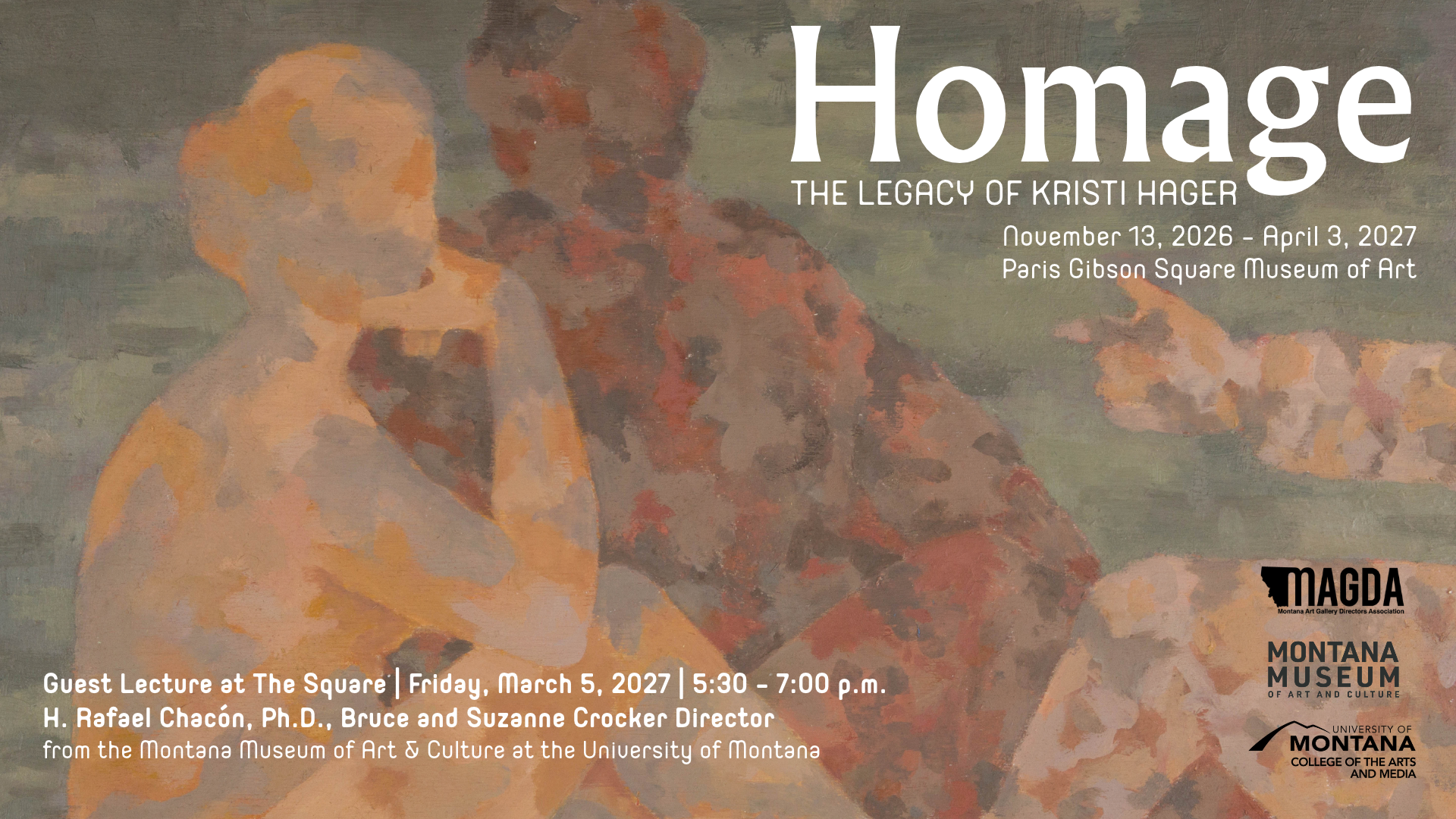
Cover Artwork: Kristi Hager, Camo Luncheon, 2015, oil on panel, 12.5 × 15.25 inches, collection of the Montana Museum of Art & Culture at the University of Montana
Related Events:
Exhibition Reception & Guest Lecture: Friday, March 5, 5:30 – 7:00 p.m. | Free to the public
Featuring H. Rafael Chacón, Ph.D., Bruce & Suzanne Crocker Director of the Montana Museum of Art & Culture at the University of Montana
About this Exhibition:
This exhibition originated at the Montana Museum of Art and Culture (MMAC) after it acquired a significant collection of art belonging to recently deceased painter, performance artist, photographer, and arts advocate Kristi Hager Kristi Hager (1946 – 2024). A longtime friend of the MMAC and university, Hager lost her struggle with cancer on November 12, 2024.
MMAC director Rafael Chacón states, “Even as we mourn the loss of Kristi Hager, we celebrate her colossal achievements as a serious painter, performance artist, photographer, and arts advocate.”
About the Artist:
Kristi Hager was born in Wilmington, DE in 1946. She received her B.A. in Architecture from the University of Pennsylvania, Philadelphia, PA. She received her M.A. in Art from the University of Delaware in Newark, DE and her M.F.A. from the University of Wisconsin-Madison, WI.
Arriving in Montana by 1981, Hager opened a studio in Butte’s Metals Bank Building. For 12 years, she never complained about working in the cold and drafty building. She loved her tall ceilings and windows as well as the expansive views of the Berkeley Pit looming over the mile-high city.
In Butte, Hager began a series of paintings and prints of isolated objects in raking light: a decorated wedding cake, a cake tin—austere still lifes in relatively empty spaces that evoked baroque memento mori even as she left them with characteristically dry, unvarnished surfaces. According to director Chacon, “These paintings were depictions of carefully selected symbolic objects, emblems that represented the individual’s journey in life and increasingly the domestic roles prescribed for women in society.”
Living with the US’s largest Superfund site in her viewshed, Hager was taken with the Berkeley Pit’s magnificent scale, strange colors, and transcendent beauty. The pit inspired two great themes across her career, plein air or out-of-door painting and environmentalism, and it catalyzed a lifetime of defending our precious natural resources.
Years later, those pit paintings led to the “Cool Water Hula,” a public performance and ritual that brought many friends to advocate for the clean-up of the site. Donning flowered leis and blue sarongs, t-shirts, and head scarves, Hager and her community danced a prayer at the edge of the pit. Hager’s re-staging the hula near the Milltown Dam east of Missoula arguably tipped public perception in favor of its removal and clean-up.
By 1994, Hager had moved to Missoula. She occasionally taught design, painting, and printmaking in UM’s School of Visual and Media Arts as an adjunct. Hawaiian-style hula and storytelling with a point of advocacy had become integral elements of her performances.
Plein air painting and drawing allowed for a continuous exploration of both formal preoccupations with light and color in the landscape and concerns over extraction, environmental degradation, and sustainability.
She embraced the challenge of rendering objects, people, and water in a variety of contexts: a backyard bird bath in strong sunlight, empty canoes floating on glimmering lakes, dappled light on the rocks, cascades, and eddies of her beloved Rattlesnake Creek, moody islands on Flathead Lake, and bathing swimmers in dazzling sunshine at Missoula’s municipal pool or the Clark Fork River.
The nude figure, particularly the female form, was of equal importance to Hager. She transformed this traditional subject of American and European art into a politically and socially charged critique of contemporary culture. Whether in aesthetic, erotic, or political settings, she saw the woman’s body as a battlefield. Her treatment of the nude, both female and male, was arguably the most radical and innovative aspect of her career.
Hager based her figural studies on years of drawing the female nude with Missoula’s Pattee Canyon Ladies Salon. This work was fully on display in the 2022 exhibition at the MMAC titled “Focus on the Figure: The Pattee Canyon Ladies Salon, 1989-2022.”
Hager reflected on the development of the female figure in a public lecture at the museum and in the exhibition catalog: “While I may have no signature style, the core of my figure work remains the messy convergence of body and mind. Within my paintings, it suggests a transitional place to pause and feel alive in this world.”
Her figural studies were not attempts at accurate representation, but rather sensitive questionings of the human condition and gender relations. Covering them in camouflage introduced a degree of threat to the subject: “My paintings of figures with camouflaged skin started as an anti-war statement that expanded to reflect unconscious chronic hyper-vigilance and lowering visibility in response to gender bias, sexual harassment and assault.”
Hager’s feminism came to the fore in 2018 in her installation “Equal: A Work in Progress.” Comprised of 21 portraits honoring her great grandmother, mother, goddaughter, friends, and hero Ruth Bader Ginsburg, the large portraits were painted on cotton scrim and hung in space so they could be viewed from either side and in relation to each other. The project, bequeathed to the Missoula Art Museum, was Hager’s, “counter offering to the ‘dude wall,’ institutional portrait galleries venerating great men.”
Photography paralleled painting and performance. Confined mainly to pictures of bridges, nuclear installations, and other government facilities, Hager’s black-and-white photographs were intended as archival records destined for the vaults of the Library of Congress. Even as they revealed loyalty to the craft within strict technical parameters, they were also a venue for her concept of the singular object in the landscape as beautiful.
Hager passed away in her home in Missoula on November 12, 2024.
Acknowledgements:
This exhibition is curated by Alissa Kost, Executive Director of the Montana Art Gallery Directors Association (MAGDA) and is sponsored by MAGDA, a state-wide service organization for non-profit museums & galleries, and supported in part by grants from the Montana Arts Council, a state agency funded by the State of Montana; coal severance taxes paid based upon coal mined in Montana and deposited in Montana's Cultural and Aesthetic Projects Trust Fund; and the National Endowment for the Arts.
This exhibition was organized at The Square by Nicole Maria Evans, Chief Curator/Director of Curatorial Affairs with assistance from Natalie Nicolson, Facilities Manager/ Preparator. Marketing designs by Sara Johnson, Culture & Engagement Manager. Exhibitions at the museum are supported in part by the Montana Arts Council, a state agency funded by the State of Montana, and the National Endowment for the Arts. We are funded in part by coal severance taxes paid based upon coal mined in Montana and deposited in Montana's cultural and aesthetic projects trust fund. Additional funding is provided by museum members and the citizens of Cascade County, Davidson Family Foundation, D.A. Davidson, Montana Credit Union, Hotel Arvon, First Interstate Bank, an anonymous donor, and Kelly’s Signs & Design.

Thank you to Kelly Signs & Design for sponsoring and creating the vinyl title signs in all of The Square’s exhibitions.
Learn more here: Kelly's Signs Great Falls MT

Thank you to Hotel Arvon for sponsoring visiting artists to share their experiences, knowledge, and artwork with the Great Falls community.
Learn more here: Hotel Arvon | Historic Boutique Hotel in Great Falls, Montana