
Jesse Albrecht: Vessels of War & Recovery
June 12 – September 12, 2026
Sponsored by Schoolhouse History & Art Center via the Montana Art Gallery Directors Association (MAGDA)
Related Events:
Exhibition Closing Reception & Artist Talk: Friday, September 11, 5:30 – 7:30p.m.
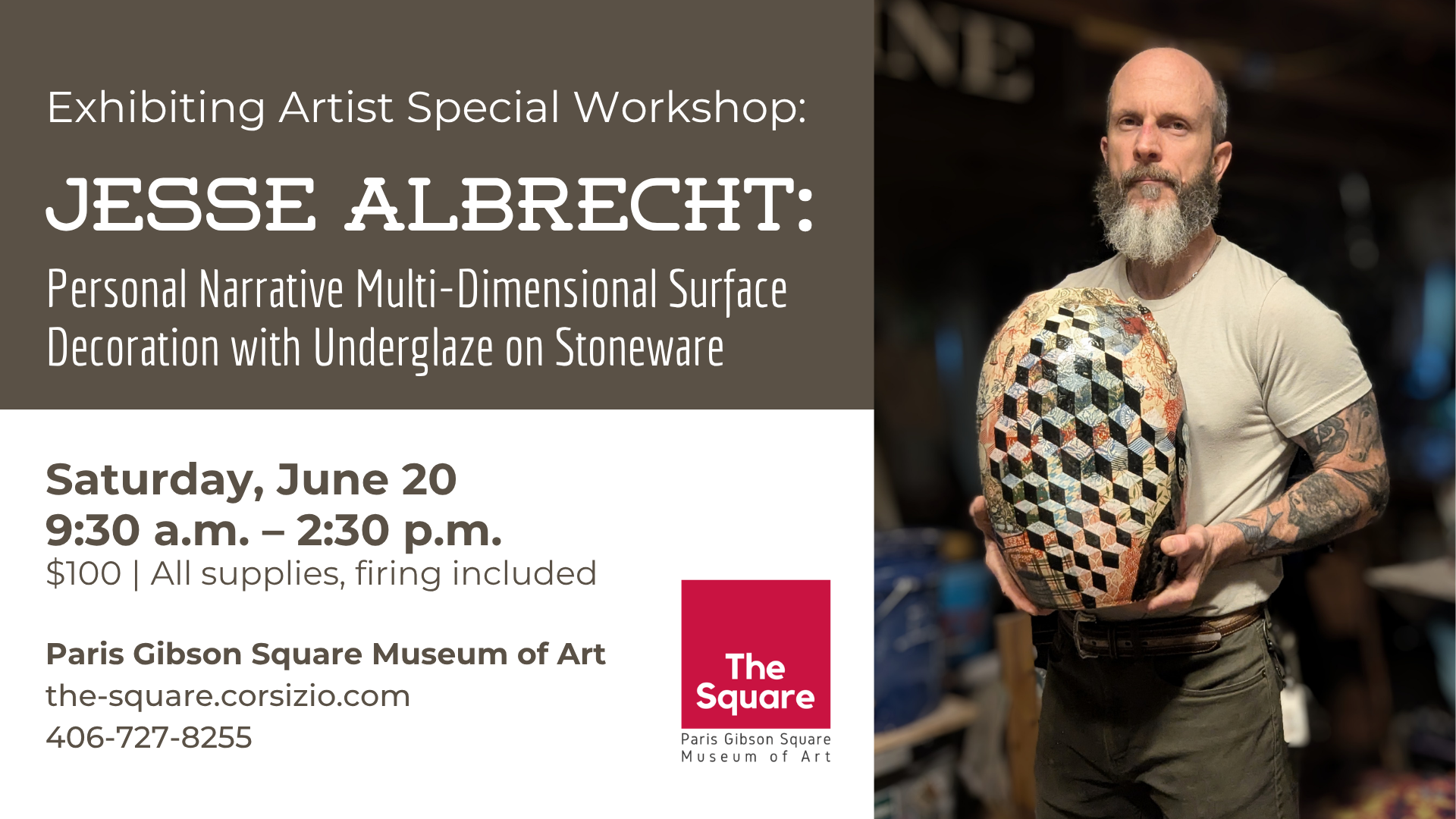
Special Exhibiting Artist Workshop (Public): Saturday, June 20, 9:30a.m. – 2:30p.m., $100/person
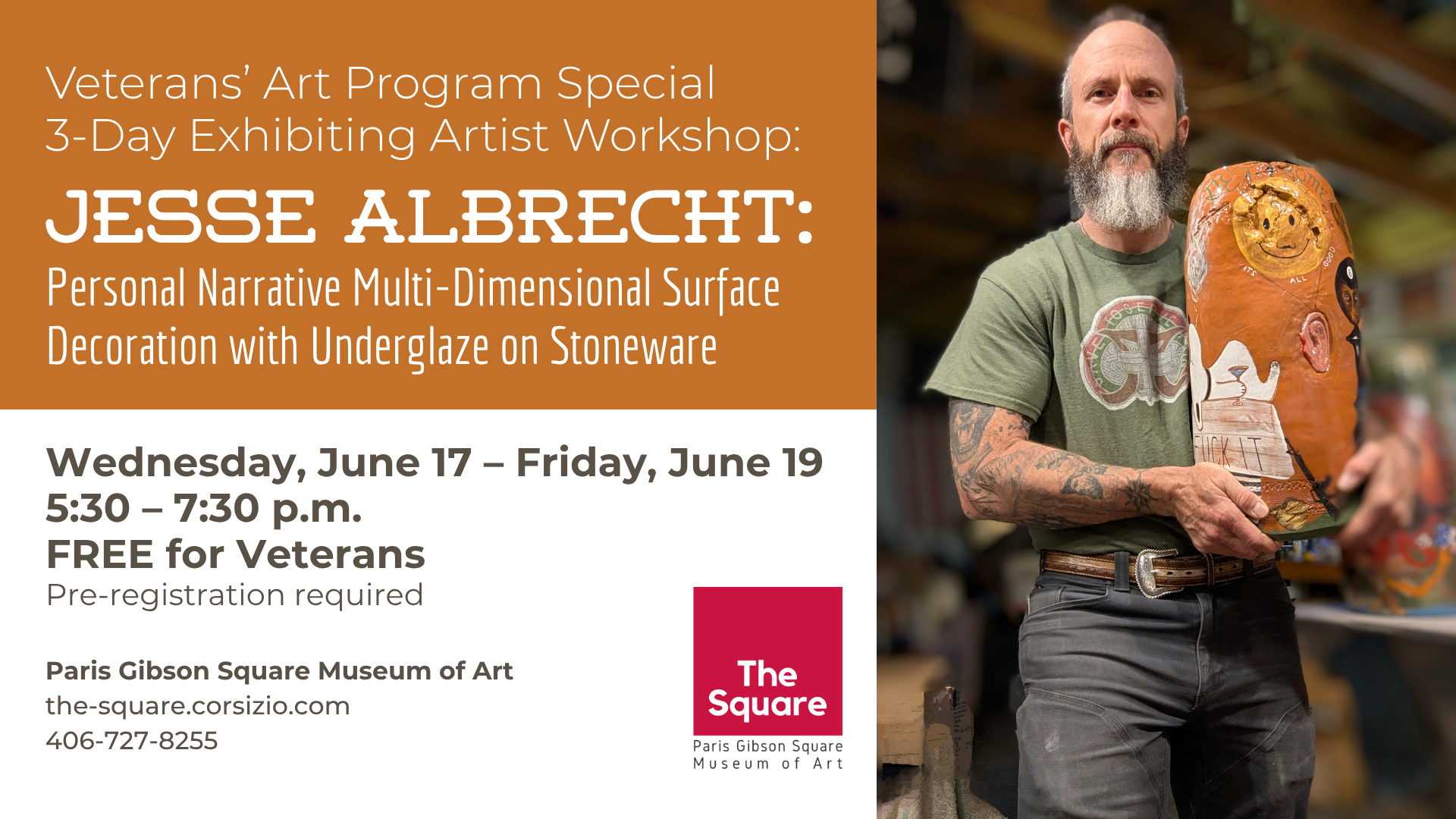
Veterans’ Art Program Special 3-Day Workshop: Wednesday, June 17 – Friday, June 19, 5:30 – 7:30p.m., FREE for Veterans only
About the Exhibition:
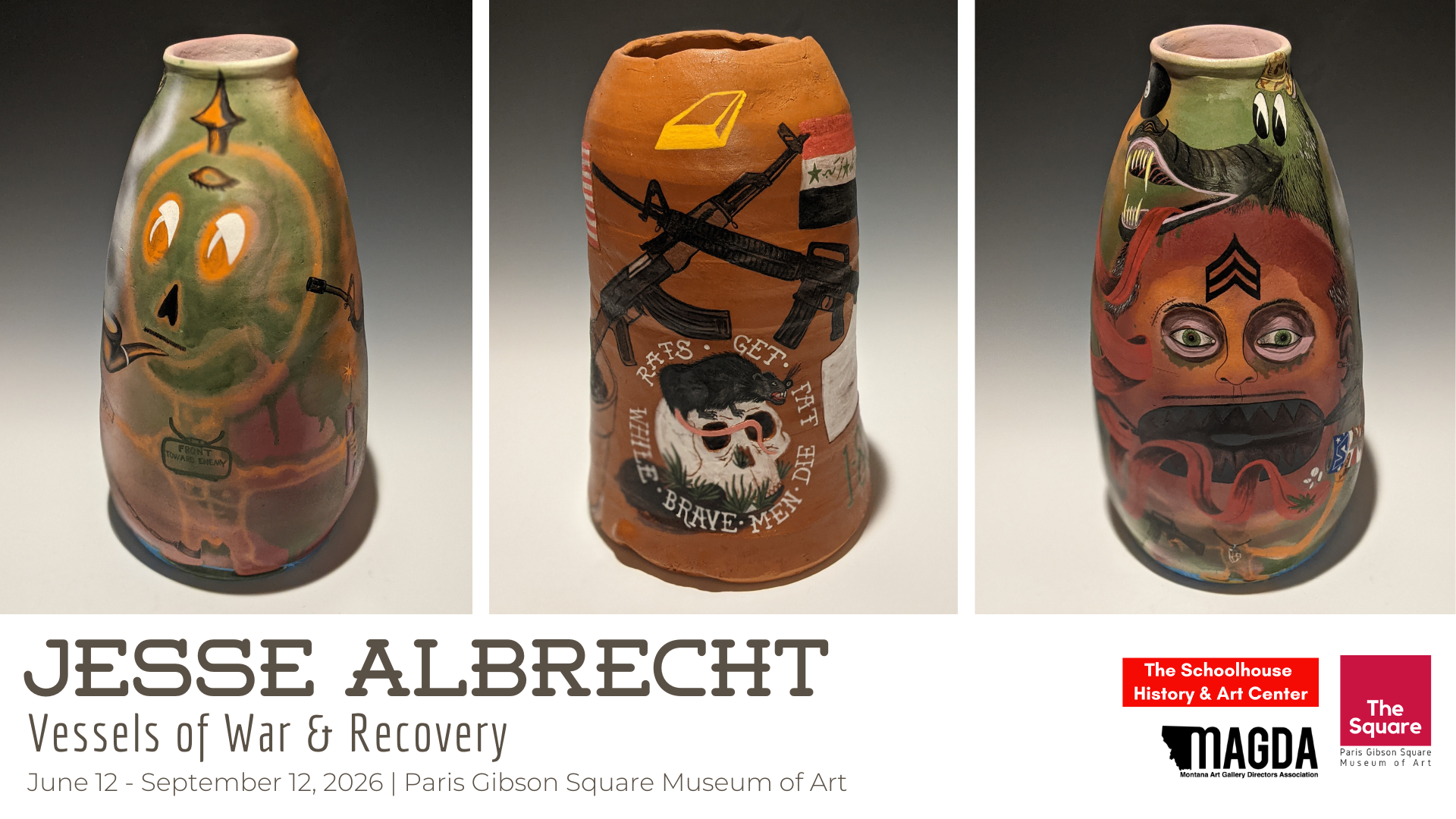
Paris Gibson Square Museum of Art presents Jesse Albrecht: Vessels of War and Recovery, an exhibition of ceramic works that explores themes of war, trauma, pain, joy, and healing through the transformative power of art.
Originally curated in 2023 by Kayla de la Ossa, Executive Director of the School House History & Art Center in Colstrip, Montana, the exhibition was developed in collaboration with artist Jesse Albrecht. The presentation also includes a companion booklet featuring essays by Albrecht, de la Ossa, artist Sean Chandler, and Alissa Kost, Executive Director of the Montana Art Gallery Directors Association.
In conjunction with the exhibition, Paris Gibson Square Museum of Art is pleased to offer exhibition related programming that expands upon its themes of recovery, resilience, and creative expression. Programs include an exhibiting artist lecture, and an art educational workshop led by Jesse Albrecht as well as a free three-day Veterans Art Program taught by the artist, an experienced arts educator who has worked extensively with veterans of war. Supported by the Montana Arts Council, the program provides veterans with an opportunity to explore artistic expression as a tool for reflection, connection, and healing.
The museum’s Veterans Art Program—the first of its kind in a Montana museum—fosters meaningful partnerships with the veteran community and Malmstrom Air Force Base, creating opportunities for engagement and support through the arts.
Jesse Albrecht's exhibition, Vessels of War and Recovery, comprises 10 large pieces of wheel-thrown pottery. These are painted with underglaze and stamped with artifacts worn and carried by him while deployed in Iraq. This work takes an unflinching and humorous look at his autobiographical journey to war and the long, hard way home.
About Jessie Albrecht:
Albrecht was halfway through his MFA in ceramics at the University of Iowa when he was deployed to Iraq with the U.S. military. His work interrogates the symbolic economy of globalism and other ideologies that animate and sustain conflict. With brutal honesty, he also explores the personal psychological aftermath of combat.
Albrecht trained under legendary ceramicist Don Reitz. Albrecht combines technical mastery with imagery and forms that range from refined and realistic to intentionally crude and even funny. Functional pottery has recently been added to his work.
His solo and collaborative work is held in numerous public collections, including the Renwick Gallery of the Smithsonian American Art Museum. He built and implemented programming in the arts for veterans of special operations, has taught in post-secondary education, and is currently a studio artist. He lives and works in Belgrade, Mont.
Artist Statement:
“I saw the live footage on 9/11, as I walked through the student union to graduate life drawing class. Three semesters later, I was in Iraq, deployed with the Iowa National Guard as a combat medic.
“They didn’t issue me my aid bag.
“They also forgot to issue the ceramic plates (SAPI — small arms protective insert) that would actually stop bullets, until just before we came home. Thankfully, we didn’t take direct fire on the 70-plus security missions outside the wire.
“Thanks to my art history classes, I was aware of the historical-cultural significance of the ruins of Nineveh, across the street from the children’s hospital in Mosul, Iraq, where we would deliver medical supplies. My work strives to be honest and accountable to the enigmatic experience of serving in Iraq, and the path “coming home” that is about recovery and redemption.
“In the Fall of 2019, I spent 2 months at the Montana VA hospital Trauma Recovery Unit, and it saved my life. The program felt like a last-ditch effort, after 16 years of desperately trying to ‘come home,’ my ‘soldier’s heart’ became increasingly debilitating — despite my best efforts ranging from Western & Eastern medicine, outpatient therapy, prescription pills, alcohol, drugs, sex and danger. Many things factored into my recovery, but being healthy for my daughter was the driving force, and God reached me firsthand in a universal, timeless truth, love and beauty kind of way.
“The imagery for Kintsukuroi is from a photo I took of a handout the Chaplain passed around during our weekly ward meeting (while in the VA hospital). I greatly appreciate the heavy-handed metaphor of being a broken pot, and that my scars make me more beautiful (they also have police point guns at me and have my art removed from shows and administrators threaten police action). My pots are formed like the Iraq war — poorly, and the surface is an attempt to mimic that of Iraq as well. I use underglaze in a painterly manner, to convey an emotional range from humor to horror--making each pot a unique composition of Iraq and coming home. Contemporary and historical are in juxtaposition. Historical military objects, specifically nose art of WWII and Zippos from Vietnam along with Empire pots of Europe and Asia are influential.
“I am recording my human experience of war, and the road home. It is contradictory and complicated, a universal story and a personal narrative. These pieces carry experiences too overwhelming to communicate with words. Some of these pieces my daughter worked directly on, others I used her drawings as reference — with her permission. She provided me with the contrast in life that is shown through her work. Thank you for your time.” — Jessie Albrecht
Acknowledgements:
This exhibition originated at the Schoolhouse History & Art Center, organized by Executive Director, Kayla de la Ossa, and is sponsored by the Montana Art Gallery Directors Association (MAGDA), a state-wide service organization for nonprofit museums and galleries, and supported in part by grants from the Montana Arts Council, a state agency funded by the State of Montana; coal severance taxes paid based upon coal mined in Montana and deposited in Montana's Cultural and Aesthetic Projects Trust Fund; and the National Endowment for the Arts.
This exhibition was curated by Nicole Maria Evans, Chief Curator/Director of Curatorial Affairs. Exhibitions at the museum are supported in part by the Montana Arts Council, a state agency funded by the State of Montana, and the National Endowment for the Arts. We are funded in part by coal severance taxes paid based upon coal mined in Montana and deposited in Montana's cultural and aesthetic projects trust fund. Additional funding is provided by museum members and the citizens of Cascade County, Davidson Family Foundation, D.A. Davidson, Montana Credit Union, Hotel Arvon, First Interstate Bank, an anonymous donor, and Kelly’s Signs & Design.
-
1. OMERTÀ ARTS
800 Front St. Helena, MT 59601
July 15 – August 31, 20252. THE HISTORIC CLARK CHATEAU
321 W. Broadway. Butte, MT 59701
September 5 – October 11, 20253. GALLERY OF ARTS – UNIVERSITY OF MONTANA
32 Campus Dr. School of Visual Arts & Media, Missoula, MT 59812
January 22 – February 20, 20264. PARIS GIBSON SQUARE MUSEUM OF ART
1400 First Ave. N. Great Falls, MT 59401
June 12 – September 12, 20265. HELEN E COPELAND GALLERY – MONTANA STATE UNIVERSITY
213 Haynes Hall. MSU – Bozeman, 59771
September 21 – November 6, 20266. MONDAK HERITAGE CENTER
120 Third Ave. SE. Sidney, MT 59270
May 24 – July 31, 20277. THE ART MUSEUM OF EASTERN IDAHO
300 S. Capital Ave. Idaho Falls, ID. 83402
August 12 – October 23, 2027